https://wondersofcambodia.com/khmer-note-why-are-there-bakus-at-the-royal-court-of-cambodia
by Pascal Medeville September 16, 2026
in Khmer notes
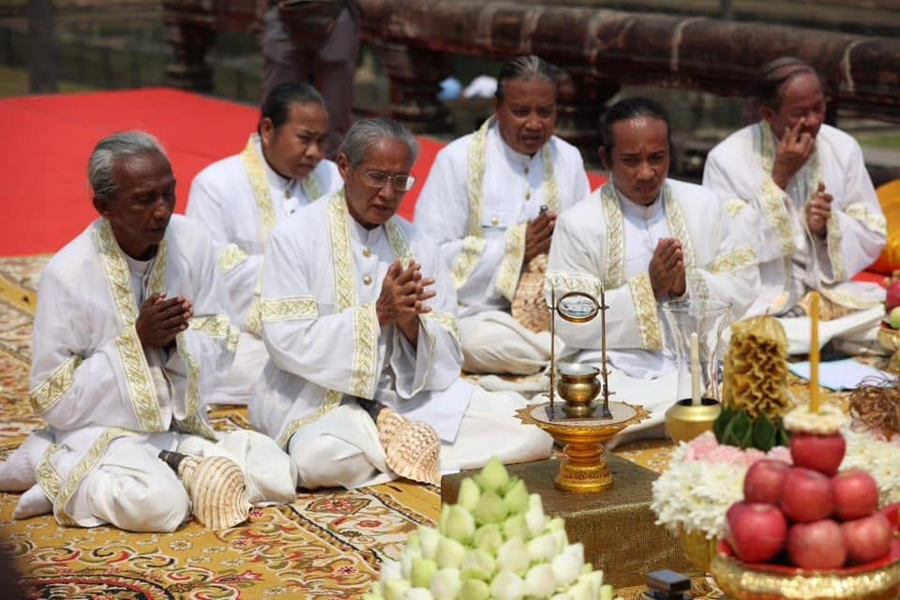
You may see them at Cambodian royal ceremonies, dressed rather differently from Buddhist monks, sometimes wearing their hair in a distinctive topknot and carrying objects that seem to belong to another civilization. They are the bakus (Khmer: បារគូ), Cambodia’s court Brahmins.
Their presence can seem puzzling. Cambodia is overwhelmingly Buddhist, and the king himself is a Buddhist monarch. So why does a Buddhist royal court still employ Brahmin priests?
The answer lies in one of the most interesting features of Khmer culture: Cambodia did not simply replace its Hindu past with Buddhism. Instead, elements of the older royal ritual tradition survived alongside Theravada Buddhism, particularly at the royal court.
The word baku refers to the Brahmin priests attached to the Cambodian royal court. Historical sources describe them as a hereditary group who performed specialized ritual functions and enjoyed particular privileges at court. Scholars have noted that they should not necessarily be understood as a conventional Indian caste transplanted intact into Cambodia. Their organization and history were more specifically Khmer.
Their importance was considerable. In the traditional royal system, the king was not simply a political ruler. His authority also had a ritual dimension, and the bakus helped maintain the ceremonies through which that sacred kingship was expressed. In other words, while Buddhist monks looked after Buddhist religious life, the bakus preserved a different ceremonial inheritance.
Their duties have traditionally included preparing sacred water, reciting ritual formulas, handling sacred objects, blowing conch shells, lighting ceremonial candles, and assisting at important royal ceremonies. Historical descriptions also associate them with the protection of royal regalia and sacred objects. They therefore appear at ceremonies involving the monarchy, rather than functioning as ordinary priests serving the general population.
One particularly visible example is the Royal Ploughing Ceremony, or Preah Reach Pithi Chrot Preah Neangkol (ព្រះរាជពិធីច្រត់ព្រះនង្គ័ល). The ceremony combines agricultural symbolism with Brahmanical ritual, including the famous moment when sacred oxen choose among seven offerings. The resulting choices are traditionally interpreted as predictions concerning the coming agricultural season.
This is the part that often surprises visitors. Cambodia’s royal ceremonies contain layers from different periods. Hindu and Brahmanical traditions became deeply embedded in Khmer ideas of kingship during the premodern period, while Buddhism eventually became the dominant religion of Cambodian society. The two traditions did not necessarily cancel one another out. Instead, some Brahmanical rituals remained associated particularly with the monarchy.
Historical accounts of Cambodian coronations, for example, describe extensive participation by the bakus alongside Buddhist clergy. During the coronation of King Sisowath in 1906, Brahmanical rites formed an important part of the ceremonies, while Buddhist monks also participated.
The survival of the bakus is partly a reminder that religious history rarely behaves like a clean timeline. Hinduism did not simply disappear when Buddhism became dominant. Certain rituals, symbols, sacred objects, court practices, and ideas about kingship continued because they had become part of the ceremonial structure of the monarchy.
The bakus are therefore less a sign that Cambodia is secretly Hindu than a living remnant of an older layer of Khmer civilization. They are, quite literally, part of the machinery of royal tradition.
Look closely at a Cambodian royal ceremony and the presence of the bakus tells you something important. Cambodian culture is not built from neatly separated historical compartments. Ancient Brahmanical traditions, Buddhist practices, royal customs, local beliefs, and modern institutions have accumulated over centuries, sometimes sharing the same ceremonial space. The bakus survived because the rituals they preserve survived. And that is perhaps the most interesting thing about them: in Cambodia, history does not always sit behind glass in a museum. Sometimes it puts on ceremonial clothes, blows a conch shell, and quietly walks beside the king.
Tags: BakuBrahmanismBrahmins in CambodiacambodiaCambodian HistoryCambodian monarchyCambodian royal courtKhmer CultureKhmer traditionsRoyal Ploughing Ceremonyroyal rituals